
What a Living Trust Really Does — and What It Does Not Protect
One of the biggest questions property owners face is this: how do you manage and protect your real estate assets in a way that is smart, safe, and sustainable for the future?
Many people have heard the term Living Trust, but not everyone fully understands what it does, how it helps with asset management, and whether it can truly protect a person from risks such as accidents, lawsuits, or bankruptcy.
The truth is that a Living Trust can be a very powerful planning tool, but it is often misunderstood. It can help with management, privacy, and inheritance planning, but it is not always the same thing as full asset protection.
Understanding that difference is extremely important.
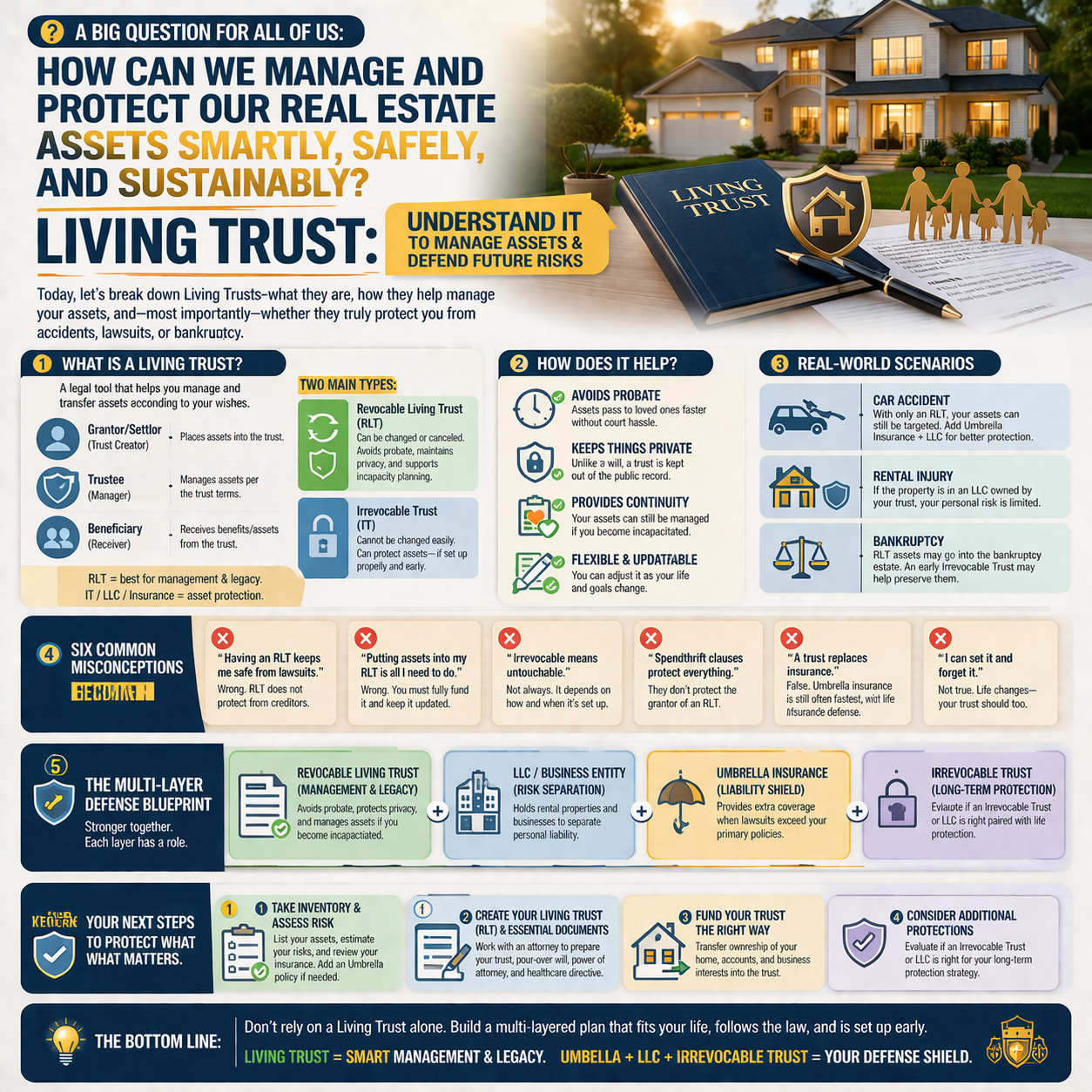
What Is a Living Trust?
A Living Trust is a legal arrangement used to hold and manage assets during a person’s lifetime and to direct how those assets are handled in the future.
There are usually three main roles involved.
The Grantor or Settlor is the person who creates the trust and transfers assets into it.
The Trustee is the person or party responsible for managing the assets according to the terms of the trust.
The Beneficiary is the person who receives the benefit of the trust assets, whether during the grantor’s lifetime or after their passing.
There are two commonly discussed types of trusts in this context.
A Revocable Living Trust can generally be changed or revoked by the person who created it. This type of trust is often used for estate planning, probate avoidance, privacy, and continuity of management if the creator becomes incapacitated.
An Irrevocable Trust, by contrast, is generally much harder to change once it is established. When designed properly and created early enough, it may be used as part of a broader long-term asset protection strategy.
In simple terms, a revocable living trust is usually most useful for management and inheritance planning. Other structures, such as irrevocable trusts, LLCs, and insurance, are often the tools people look at when thinking about stronger protection against creditors, lawsuits, or major financial exposure.
Why So Many People Use a Living Trust
A Living Trust can offer several important benefits.
One major advantage is that it may help families avoid the probate process. Instead of requiring assets to go through a lengthy court procedure after death, a properly structured trust can help those assets transfer more smoothly to loved ones.
A trust can also help preserve privacy. Unlike a will, which may become part of the public record, a trust generally allows family and financial matters to remain more private.
Another important benefit is continuity. If the person who created the trust becomes ill, incapacitated, or unable to manage their affairs, the trustee can continue managing the assets according to the trust’s instructions. This can provide stability and avoid unnecessary disruption during a difficult time.
A Living Trust can also be updated as life changes. Families grow, financial situations shift, and long-term goals evolve. A properly maintained trust structure can often be adjusted to reflect those changes.
Where People Get Confused
One of the most common misunderstandings is assuming that a Living Trust protects assets from every type of future risk.
That is not necessarily true.
A Revocable Living Trust is often excellent for asset management, privacy, and inheritance planning. But in many cases, it does not serve as a full shield against lawsuits, creditor claims, or bankruptcy exposure. If someone believes a revocable trust alone will protect them from all future legal or financial risk, that assumption may create a false sense of security.
This is where it becomes important to separate estate planning from asset protection. They often work together, but they are not the same thing.
Real-World Risk Scenarios
To understand this more clearly, it helps to think through a few practical situations.
If someone is involved in a serious car accident and faces a major claim, simply holding assets in a revocable living trust may not prevent those assets from being pursued. In that kind of situation, liability insurance and umbrella coverage are often discussed as part of the first line of protection.
If someone owns rental property and a tenant or guest is injured, the ownership structure of that property becomes very important. In many cases, people explore the use of an LLC to help separate and contain liability associated with a rental or business activity. That structure may then be coordinated with the broader estate plan.
If bankruptcy ever becomes an issue, a revocable living trust generally may not provide the same level of protection people assume it does. Certain irrevocable trust strategies, when created early and structured properly, may offer stronger protection in long-term planning situations. But timing, legal design, and personal circumstances matter greatly.
That is why no single document should be viewed as a complete answer for every type of risk.
Common Misunderstandings About Trusts
There are several beliefs that come up again and again.
One is the idea that having a revocable living trust automatically makes a person safe from lawsuits. That is not how many people should think about it.
Another is the belief that once assets are titled into a trust, everything is done. In reality, a trust often needs to be properly funded, maintained, and updated over time. If assets are not transferred correctly, the trust may not work the way the owner intended.
Some people also assume that an irrevocable trust is untouchable in every situation. That is too simplistic. An irrevocable trust may offer stronger planning benefits in certain cases, but it is not an automatic or universal shield.
Others believe that trust provisions alone can replace insurance. They cannot. Insurance, especially umbrella liability coverage, is often one of the most practical and cost-effective layers of protection a person can have.
A Smarter Strategy: Layered Protection
The better way to think about asset protection is often as a layered structure rather than a single solution.
A Revocable Living Trust may serve as the foundation for management, inheritance planning, privacy, and avoiding probate.
An LLC or company structure may help separate liability when a person owns rental property or operates business activities.
Umbrella insurance may provide an additional layer of personal liability protection and is often one of the simplest tools to add.
An Irrevocable Trust, when appropriate and created early enough, may be part of a more advanced long-term planning strategy for preserving assets.
Each tool serves a different purpose. The strength comes from how they are combined, not from assuming one document can do everything.
Practical First Steps to Consider
For many property owners, the first step is to create a clear picture of what they own and where their risk may exist.
That includes reviewing real estate holdings, business interests, financial accounts, and current insurance coverage. It may also mean considering whether umbrella insurance should be added or expanded.
The next step is often working with a qualified estate planning attorney to prepare the core documents. These may include a living trust, a pour-over will, powers of attorney, and health care directives.
After that, it is important to properly fund the trust. That means making sure real estate, accounts, ownership interests, and other assets are actually transferred or aligned the right way. A trust that is never properly funded may not provide the intended benefits.
From there, property owners may evaluate whether additional structures such as an LLC or an irrevocable trust make sense for their goals, risk profile, and long-term planning needs.
Final Thoughts
A Living Trust is an important and valuable legal tool, but it should be understood for what it truly is.
It can help with smart asset management. It can help families avoid probate. It can help maintain privacy. It can help ensure continuity if someone becomes unable to manage their affairs. Those are meaningful benefits.
But a Living Trust alone is not always a complete defense against lawsuits, creditors, or bankruptcy risk.
That is why long-term protection is often strongest when built in layers. Estate planning, liability protection, business structuring, and insurance each play a different role. When put together properly, they can create a much more durable strategy for protecting both property and peace of mind.
The goal is not just to hold assets. The goal is to manage them wisely, protect them appropriately, and prepare early instead of reacting later.
Do you currently have a Living Trust in place, or are you still exploring how to better protect your assets for the future?
This article is for general informational purposes only and is not legal, tax, or financial advice. Anyone considering a trust, LLC, insurance strategy, or asset protection plan should speak directly with a qualified attorney, CPA, or licensed financial professional about their specific situation.
Contact
Phat Phan (Paul Phan)
Maison by Phan | Frontier Realty
DRE#: 02226917
Call/Text: 714-717-8088
Email: Paul@maisonbyphan.com
