

Thinking About Building an ADU in California? Here’s What Homeowners Should Know
If you are thinking about building an ADU behind your home — whether for rental income, multi-generational living, or to increase your property value — this may be one of the best times to start planning.
Because of California’s evolving housing policies, building an ADU has become more accessible than ever in many areas. But while the opportunity is real, the process still requires careful planning, the right team, and a clear understanding of local rules from the beginning.
An ADU can be a smart long-term investment, but success depends on choosing the right type of unit, preparing the correct plans, understanding the permit process, and making sure the design actually fits your goals.
Start by Choosing the Right Type of ADU
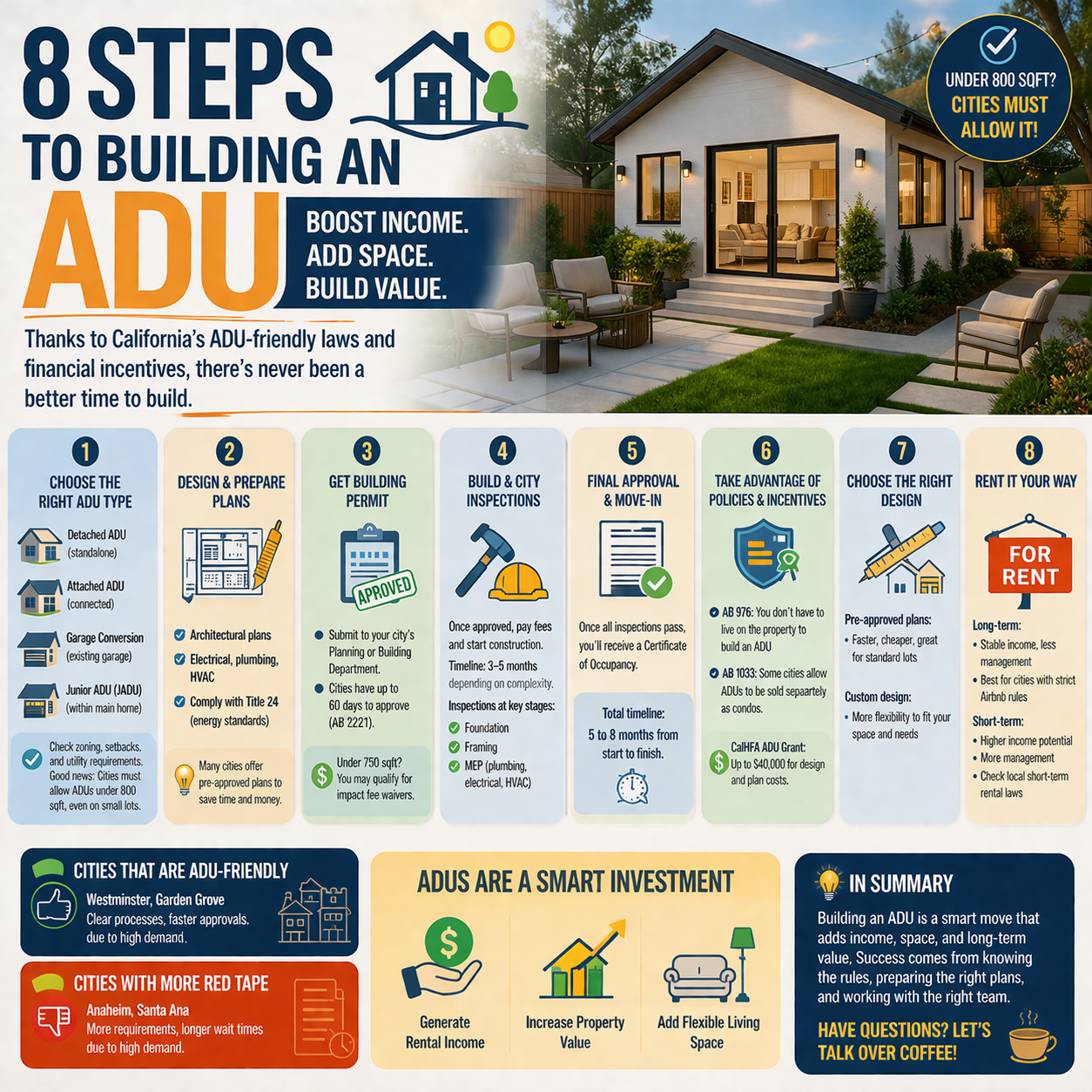
The first step is deciding what kind of ADU makes the most sense for your property and your needs.
Some homeowners choose a detached ADU, which is a separate structure built independently from the main house. Others may prefer an attached ADU, which is connected to the primary residence but functions as its own living space.
For properties with an existing garage, a garage conversion may be the most efficient option. In some cases, a junior ADU, often called a JADU, may also be possible by converting existing interior space within the home, such as part of the house or an attached garage area.
The right choice depends on the size of the lot, the layout of the existing improvements, utility access, setback requirements, and the city’s development standards. One important point many homeowners are encouraged by is that under California state law, ADUs under 800 square feet are often allowed even on smaller lots, as long as the project meets the qualifying standards.
Design and Technical Plans Matter More Than Most People Expect
Once you identify the type of ADU you want to build, the next step is preparing the design and technical plans.
This usually means working with an architect, designer, or ADU planning team to create a complete set of drawings that include the architectural layout, electrical system, plumbing, mechanical components, and HVAC. The project also needs to comply with California’s Title 24 energy efficiency requirements, which play a major role in residential construction.
This stage is one of the most important parts of the process because mistakes here can lead to delays later.
In some cities, homeowners may also have access to pre-approved ADU plans. These can help save time and reduce design costs, especially if the lot conditions are straightforward and the homeowner does not need a fully custom layout. Pre-approved plans can be a very practical option for those who want a simpler and faster path forward.
Understanding the Permit Process
After the plans are complete, the project moves into the permit stage.
At that point, the application is typically submitted to the city’s Planning Department or Building Department for review. This is where zoning compliance, building standards, and plan completeness all come under closer examination.
For many homeowners, this is the stage that feels most overwhelming, because even a good project can stall if the paperwork is incomplete or the design team misses details the city wants addressed.
The good news is that California has continued pushing cities to streamline ADU review. In many cases, there are now defined timelines for local review, which can help reduce uncertainty compared to the past.
Another important financial detail is that smaller ADUs may qualify for reduced fees. In many cases, ADUs under 750 square feet may be exempt from certain impact fees, which can lower the upfront cost of the project by several thousand dollars.
Construction Timeline and City Inspections
Once permits are approved and fees are paid, construction can begin.
The building timeline will vary depending on the complexity of the project, site conditions, contractor availability, and whether the ADU is detached, attached, or a conversion. In general, construction may take several months from start to finish.
During the build, the city will inspect the work at different stages. These inspections typically include the foundation, framing, and mechanical, electrical, and plumbing systems. Final approval is only granted after the work passes each required phase.
Once everything is completed properly, the city issues a Certificate of Occupancy, which confirms that the ADU is legally approved for use.
From the earliest planning stage through final completion, many ADU projects take roughly five to eight months, though the exact timeline can vary depending on the city and the complexity of the build.
Policies and Opportunities Homeowners Should Know
One reason ADUs have become such a popular topic is that California law has opened the door to more opportunities for homeowners.
In many situations, owner-occupancy requirements have been relaxed, which means some homeowners may not need to live on the property in order to build an ADU. This creates more flexibility for investors and families who want to add value to a property without being limited by older occupancy rules.
There are also new conversations in some jurisdictions about allowing ADUs to be treated more independently, which can create future opportunities for ownership structuring or resale under specific local programs.
In addition, financial assistance programs have been introduced to help offset some of the early costs associated with ADU planning. For homeowners considering design work, permits, and pre-construction expenses, these programs may be worth exploring carefully with qualified professionals.
Should You Use a Pre-Approved Plan or a Custom Design?
This depends on your priorities.
If your goal is to move quickly, reduce design costs, and keep the process simpler, a pre-approved plan may be the better fit. This can work especially well when the lot is relatively standard and the homeowner’s needs are straightforward.
On the other hand, if you want to maximize the use of a unique lot, work around slope or access issues, create a more customized layout, or design specifically for future rental performance, a custom ADU plan may be the stronger choice.
Custom design usually offers more flexibility, but it often comes with a longer timeline and higher upfront design costs.
Should You Rent the ADU Short-Term or Long-Term?
Once the ADU is complete, the next question becomes how you want it to function.
For some homeowners, long-term rental is the most practical option. It often provides more predictable income, less day-to-day management, and fewer complications in cities where short-term rentals are restricted.
For others, short-term rental may appear more profitable, especially in high-demand areas. But this usually comes with more active management, more turnover, and greater dependence on city regulations and local enforcement. It can work well in the right location, but it is not the right fit for every owner.
The best rental strategy depends on your property, your city, your lifestyle, and how involved you want to be after the ADU is finished.
Local Experience Can Make a Big Difference
One thing many homeowners do not realize until they start is that the ADU process can feel very different from city to city.
Some cities have clearer procedures, more responsive departments, and smoother review timelines. Others may have heavier demand, more layers of review, or more complex local expectations that can slow things down.
That is why having a knowledgeable team matters. A good ADU strategy is not just about the design itself. It is also about understanding how to move through the city process efficiently, avoid preventable delays, and set the project up properly from the start.
Final Thoughts
Building an ADU can be a smart way to create rental income, expand living space, support family members, and increase the long-term value of your property. But like any strong investment, it works best when it is planned carefully.
The homeowners who do well with ADUs are usually the ones who take time to understand the rules, evaluate the property correctly, prepare the right plans, and choose the right professionals before construction begins.
If you are considering building an ADU and are still trying to sort through the possibilities — from the design stage to the permit process and long-term use — it helps to talk through the strategy early rather than waiting until problems arise.
The opportunity is there, but the planning is what makes it successful.
Are you thinking about building an ADU for rental income, family use, or long-term property value?
Contact
Phat Phan (Paul Phan)
Maison by Phan | Frontier Realty
DRE#: 02226917
Call/Text: 714-717-8088
Email: Paul@maisonbyphan.com
